
THE OLEO WARS
“A bitter battle over bogus butter”
Jerry Banik, November 2026
An article about margarine on the Whiting-Robertsdale Historical Society web site? Sure! Discovering little things that we may not have known about the past can help give us a broader perspective of our own times gone by.
History can be about little things.
Little things
The obscure history of margarine certainly falls in the little things category.
For nearly a century, just as in towns all across America, folks in Whiting and Robertsdale were affected by what were referred to as the Oleo Wars. Chances are you’re familiar with Fleischmann’s, Imperial, Blue Bonnet, Parkay, Good Luck and many others, but you likely don’t give margarine a thought other than when you’re spreading it on your toast. The older you are though, the more likely you are to have entirely different memories of margarine in your home than younger folks have today. Maybe Mom told you stories.
When it was first introduced here as a substitute for butter, margarine was also called butterine, but it’s seldom called that any more.
Also referred to as oleo and oleomargarine, margarine is produced primarily from beef suet or tallow, unlike butter which is produced from milk. Its name comes from the Latin word for olive oil, “oleum,” and “margarites,” the Greek word for pearl.
It’s believed margarine was invented in 1869 in France, when food shortages and military needs prompted France’s Emperor Napoleon III to offer a reward to anyone who could create a cheap, durable, and readily available alternative to butter, and an enterprising man did just that. Soon margarine was spreading across America (no pun intended).
The Indianapolis News, on January 12, 1874, wrote about this new, artificial butter called oleomargarine, that swept through London and Paris, then New York and Boston.
“The effect it will have upon the cow question is a problem which we leave to the grangers and students of natural history.” Clicking on the image will enlarge it for easier reading.
Dairy farmers feared economic ruin. Claiming the entire butter trade was in jeopardy, New York’s “Butter and Cheese Exchange” fired the first shot in what has been referred to as the Oleo Wars.
For the next seventy-five years or so, you could hardly pick up a newspaper without seeing a story about oleo and oleo fraud.
It’s not nice to fool Mother Nature
The Exchange claimed fraudsters were selling a “spurious compound known as oleomargarine which has been forced upon the market, and sold under the name of butter.”
They sought federal government protection from oleo fraudsters who, they said, were selling tons of it “in Welsh tubs and half firkins.”
A typical firkin.
Welsh tubs were small wooden vessels or tubs for butter, lard, etc., and a firkin was a small one, representing roughly a quarter of a barrel.
In 1911, John F. Jelke, one of the nation’s largest margarine manufacturers, was convicted of tax evasion, spent two years in the slammer, and nearly lost his company for having run a scheme he concocted with bootleggers that centered around illegally marked firkins.
The Butter Exchange reported that “the fat of dead horses and other offal has been introduced into the so-called butter,” and that “at moderate temperature it liquifies, and soon turns to rancid oil.”
A little, multi-million dollar margarine punctuation mark
In 1886, the federal government passed a law imposing oleo taxes and licensing fees, but ended up making one of the most infamous and costly punctuation errors in legal history.
The color of natural margarine is a pale white. Manufacturers were secretly coloring their oleo with annatto, a yellowish-red dye made from a tropical tree, to make it look like real butter, and it was highly competitive with butter because it cost far less.
The 1886 act defined oleomargarine as including “vegetable-oil annotto and other coloring matter." But because Congress omitted a comma between the words "vegetable-oil" and "annotto" (the yellow food dye), which inadvertently combined the two words into a single ingredient. Manufacturers began making their margarine with vegetable-oil but using a different coloring agent. This technically put their margarines outside the legal definition of "oleomargarine," making them exempt from margarine tax and licensing fees. A decades long battle ensued until the U.S. Supreme Court finally ruled in 1932 that tax laws must be construed strictly as written. By that time, the error had stood for over forty years, and cost the U.S. government millions of dollars in lost tax revenue.
In addition to federal laws, dairy lobbyists continually pushed individual states to enact laws to suppress the booming oleo market.
Some states complied, banning oleo sales entirely. Others allowed white, but banned the sale of the yellow-colored variety. If consumers wanted it yellow, they had to buy white margarine and manually mix in a packet of yellow food dye at home.
Some states forced producers to dye their product unappealing colors, like pink. Still others allowed yellow margarine but imposed high taxes on it to keep its price at the store artificially high.
A different kind of moonshiner
Despite all the laws, oleomargarine bootlegging went on almost unabated. Unscrupulous merchants bought cheap white oleo, colored it in secret facilities, and sold it at a premium as "genuine country butter." When caught, the "oleo moonshiners" could face steep fines and prison sentences. Many were indicted, arrested and convicted.
In one interesting case, though, an arrest didn’t hold up. In 1880, “butter men” had arrested a man named Thomas McGrath on a charge of selling oleomargarine as butter. McGrath came to court with several specimens of the artificial stuff and real butter, and invited an expert, selected by the butter men, to identify which was which. The expert and a number of butter dealers couldn’t determine which was which. The judge decided McGrath could not be convicted for selling as butter a product which butter experts could not distinguish from the real article.
Hammond and Whiting were frequent targets for federal crackdowns on illegal, untaxed, or mislabeled margarine operations.
In 1909, The Hammond Times praised the “clever detective work” of a government revenue collector in Hammond, C.L. Larue. The Times stories said he cracked a case of illicit oleomargarine colorers in South Bend in an “exciting and famous raid.”
Two short years later, in 1911, The Times wrote another story involving revenue collector Larue. This time it was “the sorry story of a betrayal of the United States government...dragged from unwilling witnesses by Judge Kenesaw M. Landis.” Larue and another Hammond officer, Harry Oldham, had been federally indicted on charges of pocketing bribes from oleo fraudsters to look the other way. Only in Da Region!
Battles continued in state legislatures, including Indiana, over the extent to which strictly local officials could penalize shops carrying butter substitutes. In 1925, the Indiana General Assembly took up House Bill 135. It aimed to require strict warning signs and heavy restrictions on the sale of margarine in both agricultural and industrial zones like Lake County. It also sought to ban the sale, distribution, or use of oleomargarine in state facilities like public hospitals, prisons, and charitable institutions that housed children.
Bill 135 passed in the Indiana House of Representatives, but it ultimately died in the State Senate. Unlike Wisconsin’s total ban of the sale of yellow margarine, Indiana ended up imposing only moderate regulations that covered margarine labeling and the posting of “margarine warning” signs in public dining establishments. Indiana imposed no special excise taxes and no restrictions on color.
In 1950, President Truman signed a bill repealing all federal taxes on margarine, but some strict states hung on to theirs. Two of America’s premier dairy states kept restrictions the longest. Wisconsin’s strict ban on yellow margarine stayed in place until 1967. Minnesota’s aggressive laws and taxes weren't fully erased until 1975.
But some things never change. Big Dairy, like most big industries, has never stopped pushing for government support. Remember government butter and government cheese? In the 1970s and early 1980s, U.S. dairy price supports guaranteed a high price for milk to protect farmers, resulting in massive overproduction. To keep milk prices high, the government bought the surplus milk, made it into butter and cheese, and stored millions of pounds of it. By the early 1980s, warehouses were overflowing, and the Reagan administration authorized giving away the excess. That served to help some households in need, but it also became a common way for antagonists to humiliate people who received the largesse.
Today margarine is no longer a covered commodity under federal agricultural price support programs. A recent check of butter and margarine prices as of this writing revealed the price of a pound of Imperial margarine at Walmart was $1.44, and Land O Lakes butter was $4.46.
You might enjoy this look at a handful of our local grocery stores’ ads over the years, clipped from various local newspapers. You may even remember having shopped at some of these places.
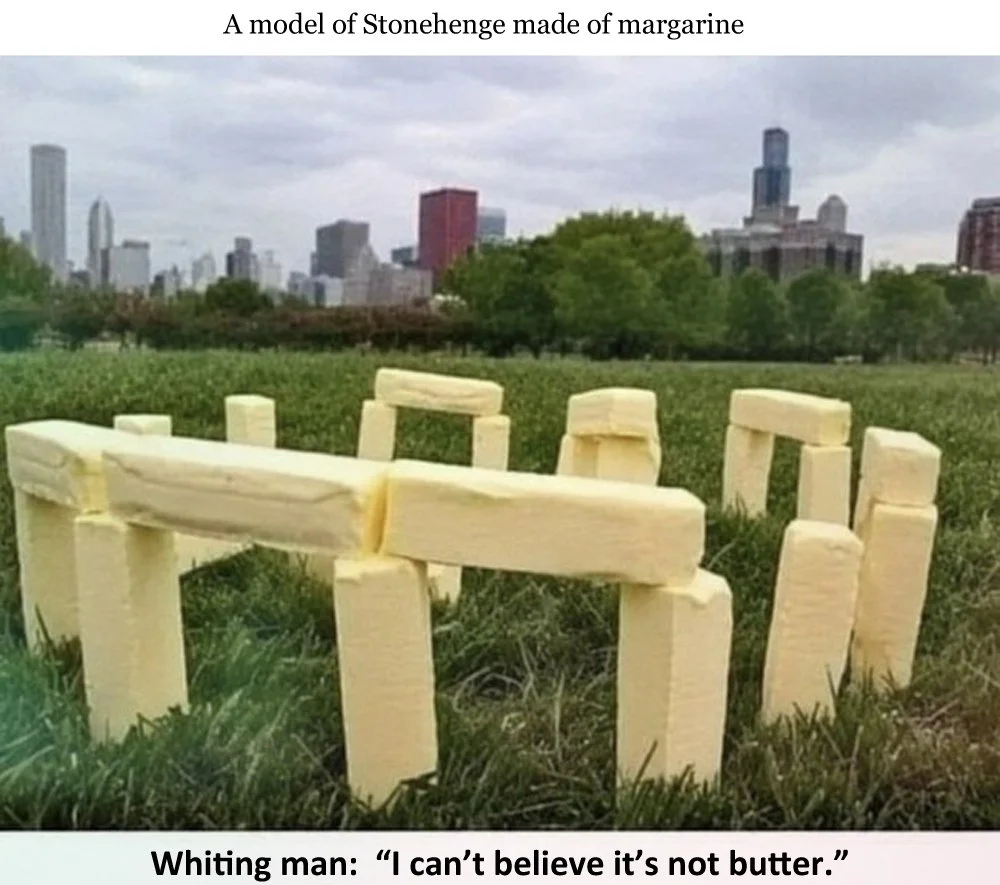
…and finally: