
Frank Brummett with two of his concert posters
Not the Same Old Song and Dance: How the Jackson Five Came to Whiting
Anthony Borgo March 2026
In 1969, America stood at a crossroads, a nation vibrating with upheaval and possibility, where the moon landing shared headlines with protests, psychedelia, and a youth culture determined to reinvent the rules. Against this restless backdrop, a young man stumbled into adulthood not through college or career plans, but through music—finding himself, almost overnight, transformed into a concert promoter from Whiting, Indiana.
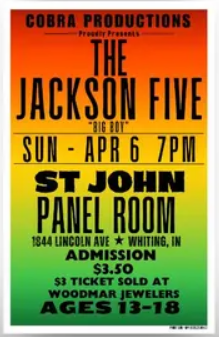
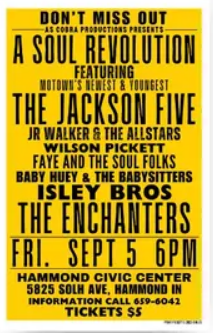
In the fall of 2023, Joseph Hajduch posted a photograph of a concert poster in the Facebook group Whiting Indiana Memories and Remember When. The poster advertised the Jackson Five headlining a concert at the St. John the Baptist Panel Room. To say I was shocked by the existence of this concert would be an understatement. More than 60 people commented on the post, many of them recalling that they had actually attended the show.
For months, I researched the concert, hoping to uncover more details, but to no avail. I was certain that the Hammond Times must have covered such a major event, yet I found nothing. And so, the mystery seemed to end there—until three years later, when a gentleman walked into the Whiting Public Library asking if we had any Clark High School yearbooks.
Frank Brummett explained that he was looking through the 1969 Powder Horn to find the name of one of his former history teachers. He mentioned, almost casually, that he was working on a memoir about being 17 years old and bringing the Jackson Five to Whiting. I was completely flabbergasted after years of unanswered questions, the person with the real story had simply appeared out of thin air. For the next hour, I sat with Frank as he shared the incredible story I am now about to tell.
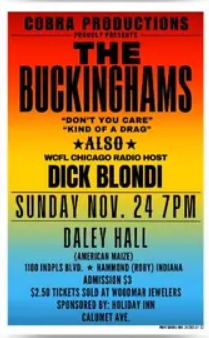
Frank explained that more than 58 years ago, his family lived in the Robertsdale neighborhood of Whiting. At the time, he was in his senior year at George Rogers Clark High School. In the autumn of 1968, his seventeenth birthday was approaching—November 24th, to be exact and together with his parents, Frank devised a plan to host a birthday celebration that would be truly unforgettable.
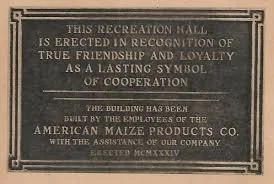
Frank’s father worked at American Maize in the Roby area of Hammond. On the Amaizo property stood Daly Hall, named after plant superintendent Raymond E. Daly. The spacious venue was part auditorium, part gymnasium, and part social hall. It regularly hosted everything from Christmas parties to community gatherings, all at no cost to employees and their families. Frank’s father was able to secure the hall for the birthday bash, setting the stage for something remarkable.
Frank’s mother was a dedicated staff member at the newly opened Holiday Inn on Calumet Avenue in Hammond, where she served breakfast to hotel guests. Among those guests were members of the popular band the Buckinghams. One morning, she mentioned her son’s upcoming birthday and his ambitious plan to throw a large party. Whether it was her genuine enthusiasm or the friendly rapport she had built with the musicians, the Buckinghams agreed—out of sheer goodwill—to perform at Frank’s celebration.
The Buckinghams were one of the most popular American pop-rock bands of the 1960s, emerging from Chicago during the height of the British Invasion and quickly becoming a staple of AM radio. Formed in 1965, the group found major success with a string of sophisticated, horn-driven hits that blended rock, pop, and orchestral arrangements, including “Kind of a Drag,” which reached No. 1 on the Billboard Hot 100 in 1967, along with “Don’t You Care,” “Mercy, Mercy, Mercy,” and “Susan.”
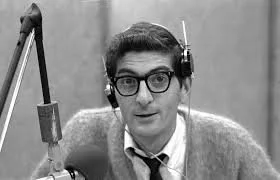
Dick Biondi
As the date of the event quickly approached, Frank mustered the courage to call Dick Biondi, the illustrious host of Chicago’s WCFL radio station, whose broadcasts reached far beyond the local airwaves. To Frank’s astonishment, Biondi answered the phone himself. Frank initially called to inquire about the cost of advertising his birthday bash on the radio, but the conversation took an unexpected turn. After only a brief discussion about the event, Biondi agreed not only to promote the party free of charge, but also to DJ the event himself for only $100.
Without ever having met Frank in person or knowing much about his background, Biondi simply said, “I like you.” Can you imagine reaching out to a local celebrity today and having them answer their own phone, let alone agree to attend a seventeen-year-old’s birthday celebration? In that moment, Frank knew his birthday would be one for the ages.
Frank then reached out to Woodmar Jewelers, who agreed to sell tickets for the party at their Hammond store. With the venue and entertainment secured, the only thing left to arrange was the refreshments. The Brummetts paid to have Arnie’s Dog House provide the food, while Coca-Cola supplied the drinks.
On the night of the party, Frank’s father and a few friends took charge of parking. The real challenge was that no one knew how to get the exterior lights in the parking lot to work, plunging the many cars circling Daly Hall into darkness. With the hall gated and shrouded in shadow, many people who had purchased tickets never made it inside. As a result of all the no-shows, the Brummetts were left with an abundance of hot dogs. Frank later recalled that even after eating hot dogs for dinner every night, it felt like they still had them “coming out of their ears.”
Mr. Metcalf, the manager at the Holiday Inn where Frank’s mother worked, volunteered to help by taking tickets at the door, a decision he would soon regret. It was bitterly cold on that late November night, and as a result, Metcalf ended up in the hospital for two weeks. Frank remembered the night as truly spectacular, yet in an ironic twist, not a single person wished him a happy birthday, a detail he still chuckles about to this day.
As the year drew to a close, a new idea began to take shape. Frank’s memories of his birthday party lingered, for something truly magical had happened on that November evening. A spark had been ignited—one that stirred in him a desire to bring more live music to the Whiting area.
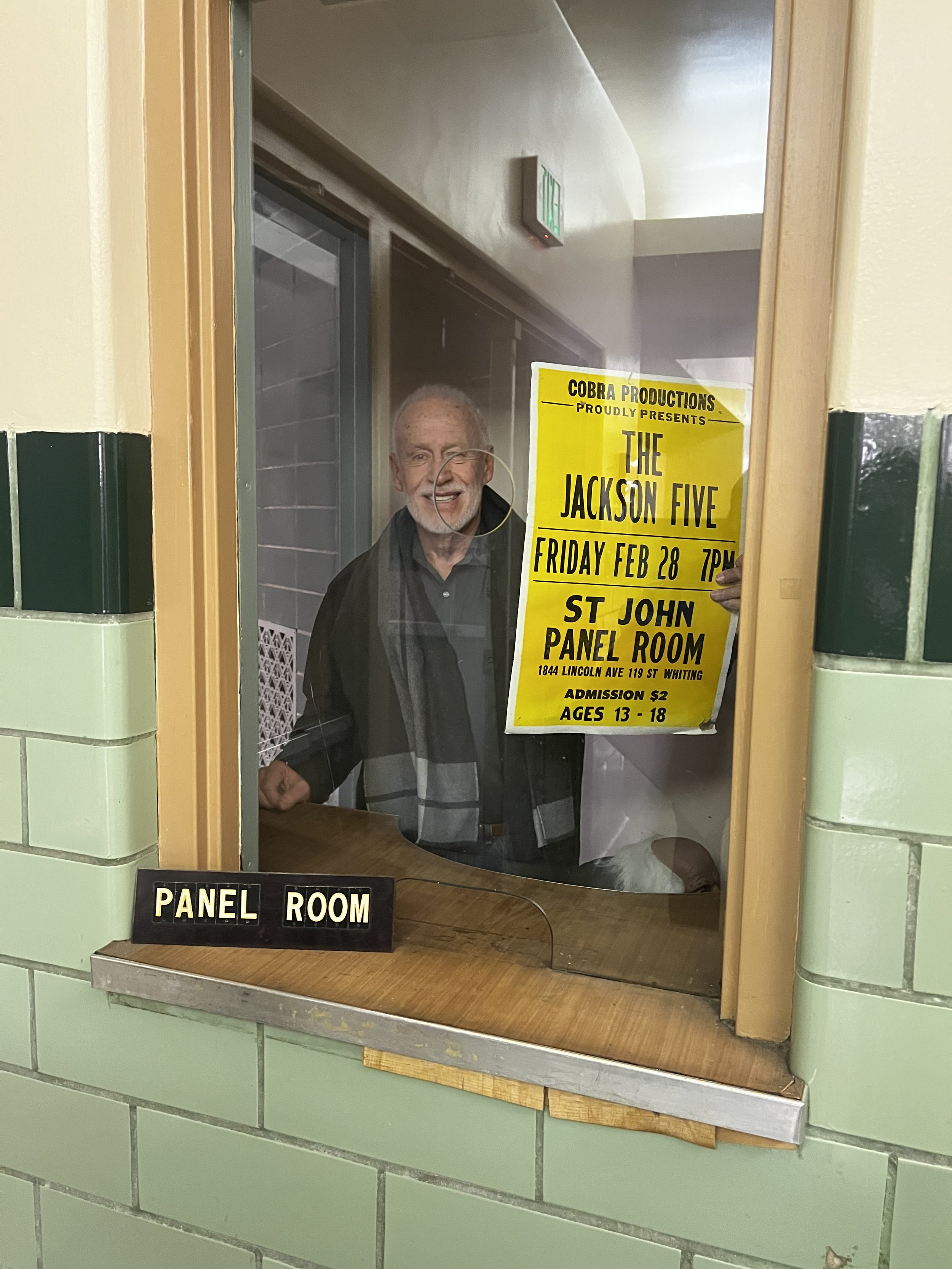
Frank Brummett where it all started
Before long, Frank crossed paths with John Gazda, the manager of the St. John the Baptist Panel Room. He shared his vision of hosting concerts in Whiting, and John agreed to let him use the Panel Room as the venue. Soon, fifteen additional shows were confirmed, with the first scheduled for Sunday, February 16, 1969. The plan called for biweekly events, alternating between Fridays and Sundays. Admission was set at a modest $2, and the concerts were designed specifically for teens between the ages of 13 and 18.
Although the venue was secured for February 16, the band originally scheduled to perform dropped out at the last minute. Fortunately, one of Frank’s teachers at Clark stepped in with a solution. Thomas Roman, his social studies teacher, also managed a band called the Hartford Convention. Roman proposed an arrangement in which he, Frank, and the band members would split the proceeds from the performance.
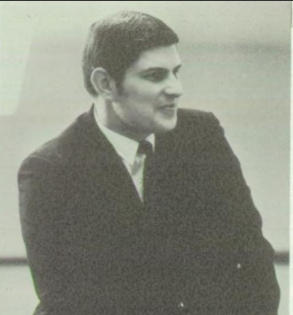
Thomas Roman
By the end of the night, the seven partners divided the modest ticket sales, each walking away with just $3. Thomas Roman was far from pleased, and the evening marked both the first and last time the Hartford Convention performed at one of Frank’s shows.
At just seventeen years old, Frank conducted himself with remarkable professionalism as a concert promoter. As he had done for his birthday bash, he made sure every show was supported by professionally printed posters. In total, sixteen different posters were produced to promote his events.
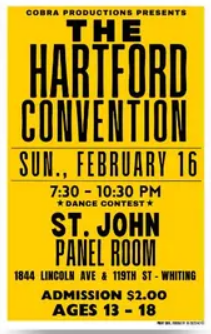
Brummett reached out to Mildred and Arvel Furr, owners of Tribune Showprint in Earl Park. Tribune Showprint was a long-established business renowned for producing bold, eye-catching concert posters for bands across the country. The Furrs guaranteed that every other Monday, Frank would receive 100 freshly printed 14” x 22” posters delivered directly to his doorstep.
Armed with stacks of posters and plenty of determination, Frank and his cousin Gary canvassed Lake County and the surrounding areas, stapling the vibrant advertisements to telephone poles ensuring that no one could miss news of the upcoming shows. This is the very same concert poster I saw on Facebook many years later.
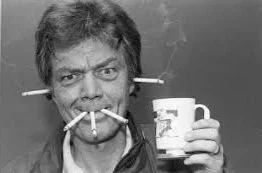
Larry Lujack
The Hartford Convention debacle was not the only setback young Frank endured in his blossoming career. Through his friendship with Dick Biondi and later Larry Lujack from Chicago’s WLS radio station, Frank was introduced to a booking agent from Indianapolis. Not wasting any time, Brummett signed thirteen contracts. The first band, Four Days and a Night, was set to perform in Whiting on February 28th.
Some time later, the booking agent informed Frank that all of his signed contracts for musical acts were being voided, as Brummett was not yet 21 years of age. As a result, every band scheduled to perform throughout the summer was abruptly canceled.
Still, all was not lost. A friend mentioned that the East Chicago VFW Hall had begun showcasing promising entertainers on Friday nights. On February 21st, Frank made the trip to East Chicago, hoping to discover new acts that could fill the sudden void in his lineup.
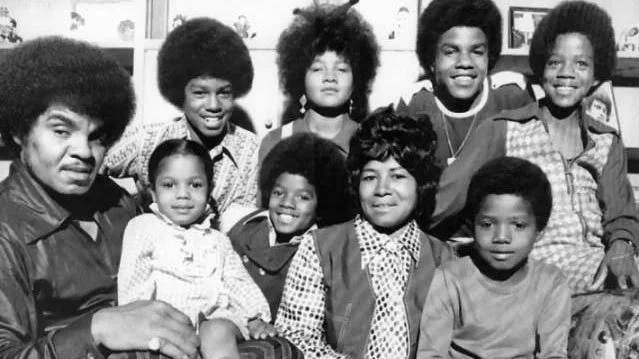
The Jacksons
To his surprise, that very night he witnessed the Jackson Five on the rise. The family band from nearby Gary, Indiana was still in its early days, but there was no denying their extraordinary talent. They electrified the crowd with a spirited performance of “It’s Your Thing,” the Isley Brothers’ hit that was climbing the charts that year.
During one of the breaks, Brummett approached the Jacksons and struck up a conversation. Curious, Frank asked whether the young performers from Gary, Indiana, had a manager. They led him to a nearby table where their father, Joe Jackson, was seated. Mr. Jackson explained that he managed the boys and asked how he could help.
Having never heard of the Jacksons before, Frank confided in him about his mounting troubles, his lack of a venue and the sudden loss of scheduled bands. As tears streamed down Brummett’s face, Joe placed a reassuring hand on his shoulder and offered calm words of encouragement: “We will get through this together.” Joe shared with Frank his own struggles, how he worked at U.S. Steel and raising six boys and three girls.Joe swore that he could not have done it without the love and support of his wife Katherine.
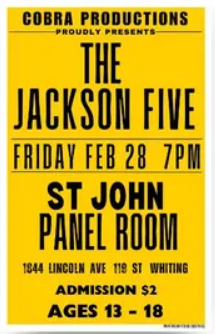
And with that, Frank Brummett successfully booked his first concert, launching his company under the name Cobra Productions. The Jacksons agreed to perform at the Saint John Panel Room on Friday, February 28th. Dick Biondi once again signed on as the DJ, charging only $100, explaining that he simply wanted to be part of something special. On the first night, a modest crowd of just twenty people showed up to witness what would become the Jackson Five’s first performance in Whiting. When it came time to settle the accounts, Frank realized he did not have enough money to pay the band. Once again, Joe Jackson reassured Brummett, telling him not to worry and promising that things would get better.
An interesting anecdote about the Jacksons performing at the St. John Panel Room comes from Susie Kwasman (nee Markovich). According to a Facebook post, Susie recalled an embarrassing moment during the excitement of the concert when she accidentally bumped into the band’s equipment, briefly causing the music to stop. For a moment that day, the music quite literally stopped.
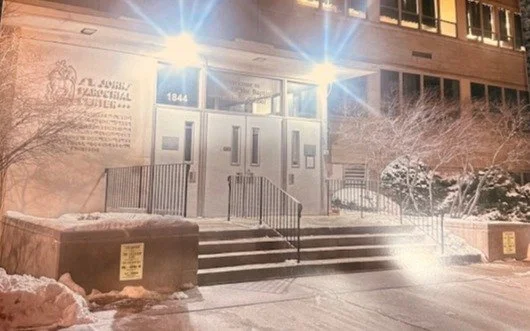
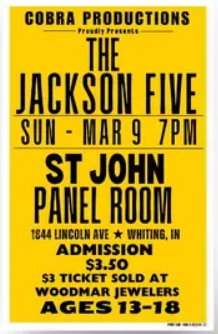
The Jacksons’ second performance in Whiting was scheduled for March 9th, and fate intervened in an unexpected way. The band’s keyboard player had forgotten his foot pedal, and without hesitation Frank rushed home to retrieve his own. As it turned out, both musicians played the same Farfisa keyboard. When Brummett returned to the Saint John Panel Room, he found it packed. Word had clearly spread after the Jackson Five’s first appearance, and a line of kids snaked down 119th Street. The crowd grew so large that the police department was called in to keep the peace.
Brummett took his place in the ticket booth, a small room tucked beside a turnstile. To admit each guest, Frank pressed a pedal that allowed the turnstile to spin, ushering in waves of excited teenage fans. The line of music aficionados seemed endless. Amid the growing chaos, Brummett abandoned the cash drawer altogether, instead tossing money onto the floor of the cramped booth. By the time the final ticket was sold and the last person passed through the turnstile, Frank found himself knee-deep in dollar bills.
Cobra Productions was now in full stride, and in that moment Brummett had never felt more exhilarated. His lifelong passion for all things green had truly begun to take shape. After that second performance, shows at the Saint John Panel Room routinely drew standing-room-only crowds. With enthusiasm continuing to build, the Jacksons agreed to return for additional bi-weekly performances, cementing the venue as a hot spot for live music in Whiting.
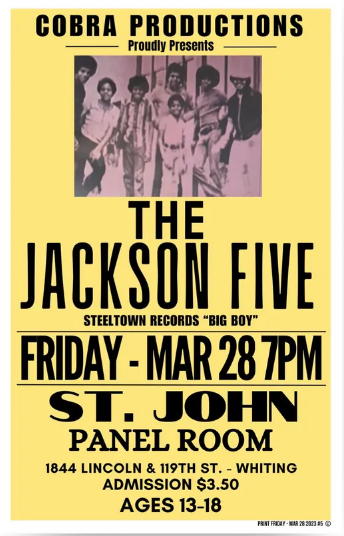
The Jacksons returned to Whiting for a third appearance on March 28. That evening, The Jackson 5 delivered a sensational performance at the St. John Panel Room, thrilling the crowd with their first hit single, “Big Boy.” Earlier in 1968, the group had recorded the song with Steeltown Records, a Gary-based recording studio and label that helped launch their career. The track was produced by Gordon Keith.
An interesting side note: the March 28 concert poster featured a photograph Frank himself had taken using a Polaroid camera, one his mother had given him as a gift, adding a personal touch to an already memorable night.
There was yet another Jackson Five concert at the St. John Panel Room on April 6. However, Whiting was in for something different just a couple of weeks later. On April 18, the Jackson Five faced off against The Enchanters in a lively Battle of the Bands event. When the night came to an end, The Enchanters emerged as the winners of the competition.
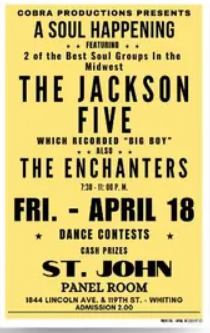
The Enchanters, sometimes billed as The Enchanting Enchanters, were a band from East Chicago, Indiana, formed in 1967. The group featured Arthur Lopez on bass, Arlis Johnson on guitar and vocals, Lucio “Beto” Barrajas on lead vocals, Val Miranda on drums and percussion, Robert Celestine on backing vocals, Alejandro Alvarez on horns, and Jon Trimble on horns.
The band recorded two soul singles during their brief but notable run. Their first release, “No One In This World / Boss Action,” appeared on the BenMoKeith label, which was owned by Gordon Keith of Steeltown Records in nearby Gary, Indiana. Their second 45, “The Struggler / Winds and Sea,” was issued on the Atco label, with involvement from both Steeltown and Dunwich Records.
April 27, 1969 marked the final Cobra Productions teen concert held in Whiting, Indiana. Church leaders had a change of heart about hosting live musical performances at St. John, ultimately deciding to end Brummett’s concert series at the venue and force the shows out of town.
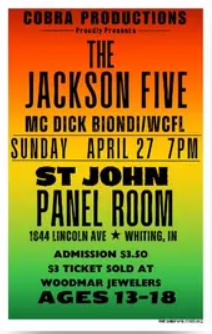
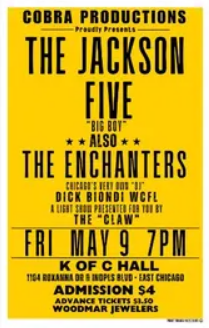
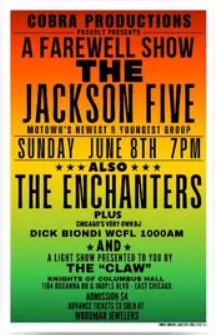
Despite the setback, all was not lost. Cobra Productions quickly found a new home and relaunched on Friday, May 9, at the newly built Knights of Columbus hall in East Chicago, Indiana. The inaugural event at the new venue featured an exciting night of music with performances by the Jackson 5 and the Enchanters, continuing the popular teen concert series in a new setting.
The new venue did not deter the public from attending Brummett’s shows. On May 18th, Cobra Productions once again featured the Jacksons and legendary radio personality Dick Biondi. However, on this particular night, a new band also took the stage, Baby Huey and the Babysitters.
Baby Huey & the Babysitters was a band formed in Gary, Indiana. Established in 1963, the group was the brainchild of organist and trumpeter Melvyn Jones along with guitarist Johnny Ross. The band’s charismatic frontman was James Ramey, who adopted the stage name “Baby Huey,” inspired by the popular cartoon and comic book character of the same name. During their early career they recorded four songs released on singles between 1964 and 1966: "Monkey Man," "Messin' with the Kid," "Just Being Careful," and "Beg Me."
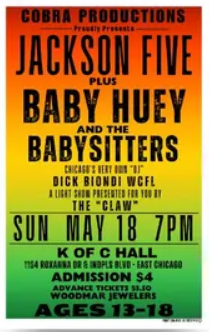
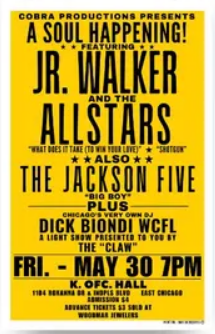
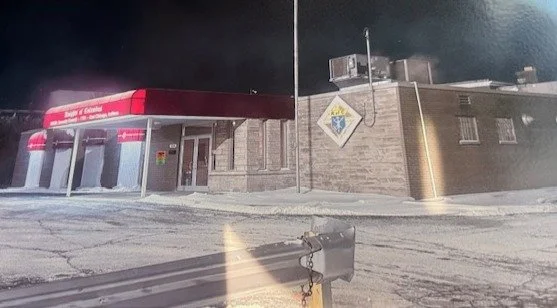
The May 30th show also featured a unique new addition. That evening welcomed back the Jacksons and Dick Biondi, but it also introduced an exciting light show performed by an individual known as “The Claw.” A local young man who had lost both of his hands and replaced them with metal prosthetic claws, refused to let his disability keep him from doing what he loved. Brummett later remarked that the way he operated the lighting board was truly remarkable, creating a dazzling visual experience for the crowd. The lineup for the night also included the dynamic group Junior Walker and the All-Stars.
Junior Walker & The All-Stars began as a band called “The Rhythm Rockers,” which later evolved into “The All-Stars” in 1961. In 1964, the group which was led by saxophonist and vocalist Autry “Jr. Walker” DeWalt Mixon Jr, signed with Motown Records. They soon gained national recognition with hits such as “Shotgun,” which reached #4 on the pop charts and #1 on the R&B charts, and the soulful classic “What Does It Take (To Win Your Love).” Known for their gritty, saxophone-driven sound and high-energy performances, the group became one of Motown’s most exciting live acts.
Following the show, Autry “Jr. Walker” DeWalt Mixon Jr. approached Frank and enthusiastically told him how much he had enjoyed the evening. He praised the event and remarked that he would be eager to work with Cobra Productions again in the future. As it turned out, Brummett had been fortunate in securing the band for the performance, having booked them for considerably less than what their manager likely would have requested under normal circumstances.
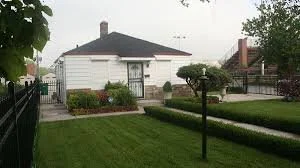
The Jacksons’ Gary, Indiana Home
Frank Brummett quickly grew close with the Jackson family during 1969 through his work with Cobra Productions. Over time, he spent many days visiting the family at their home in Gary, Indiana. One of those visits proved to be truly historic. While sitting in the Jackson family’s kitchen, Frank witnessed the phone call that would forever change the group’s future. Berry Gordy, president of Motown Records, called to invite the Jackson Five to audition for the label. The audition would take place at one of Gordy’s famous backyard parties. Because of that momentous opportunity, Brummett promoted the June 8 show as the “Farewell Show,” marking what would be Cobra Productions’ final concert featuring the Jackson family before their rise to national fame.
On June 20, Cobra Productions introduced a new act to the East Chicago stage. This time, the featured performers were The Dells, an American R&B vocal group with deep roots in the genre. The group had originally formed in high school in 1953, when founding members Marvin Junior, Verne Allison, Johnny Funches, Chuck Barksdale, and brothers Michael and Lucius McGill came together under the name the El-Rays. They released their first recording in 1954 and, two years later, scored their first R&B hit with “Oh What a Night.” Although the group briefly disbanded after a near-fatal car crash in 1958, they reunited in 1960, with Johnny Carter replacing Johnny Funches in the lineup.
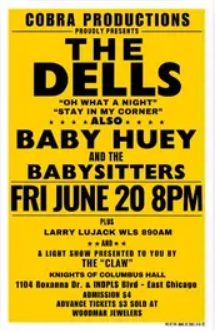
Also appearing that evening were Baby Huey and the Babysitters, whose powerful stage presence electrified the audience. The group brought the crowd to its feet with a stirring rendition of “Hard Times,” further cementing the night as another memorable chapter in the Cobra Productions concert series.
A few days before the June 29th show, Frank was approached by William “Bill” Passmore, a familiar and respected figure in East Chicago. Passmore had earned acclaim for his resilience after losing both legs in high school and, in 1969, was honored by President Richard Nixon as “Handicapped American of the Year.” He was also a contributor to the Chicago Defender, writing the popular “East Chicago on the Go” column. Passmore told Brummett that he had been following his efforts with the Knights of Columbus and admired the work he was doing.
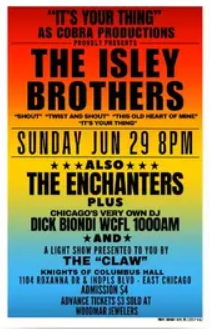
The June 29th concert lineup featured the Isley Brothers, the Enchanters, a light show by “The Claw,” and Dick Biondi. The Isley Brothers were among the most influential and enduring groups in American rhythm and blues. Formed in the early 1950s in Cincinnati, Ohio, by brothers O’Kelly Isley Jr., Rudolph Isley, and Ronald Isley, the trio first gained national attention with their explosive 1959 hit “Shout.” Blending gospel roots with the emerging sounds of R&B and rock and roll, they became known for their energetic performances and powerful vocals. During the 1960s, the group recorded for Motown, releasing songs like “This Old Heart of Mine (Is Weak for You),” before achieving even greater success in the 1970s with an expanded family lineup that included Ernie Isley and Marvin Isley.
Bill Passmore, right
At the time, Frank was planning an ambitious series of eight weekly shows, beginning on July 11 and culminating in a September 5 final blowout at the Hammond Civic Center. His goal was to secure top acts such as Jessie and the Earls, Sam & Dave, Wilson Pickett, the Enchanters, Stevie Wonder, and Jr. Walker & the All Stars, creating a truly spectacular series of events.
However, right before the June 29th concert, Passmore approached Frank again, and his demeanor had shifted dramatically. Although he had admired Frank’s initial efforts, he now warned that the young promoter might be taking on more than he could handle. Passmore expressed deep concern over the financial risks Frank was assuming, cautioning that a misstep could leave him financially ruined and entangled in lawsuits.
The warning struck fear into Frank. Soon after, he asked Passmore how much he would pay to take over the final ten concerts. Passmore replied that the risk itself was more valuable than any monetary offer he could make and urged Frank to consider it his chance to save himself from a sinking ship. Overwhelmed by fear and inexperience, Brummett ultimately agreed to let Passmore take over Cobra Productions’ final shows.
Frank could not bring himself to attend the final concerts. Knowing that his brainchild was now in someone else’s hands was simply too difficult. Later, friends told Brummett that the Civic Center parking lot had been overflowing with eager fans.
Not long after, Frank took a job at Inland Steel, though the position proved to be short-lived. He soon joined the United States Air Force, where he served his country for six years. After leaving the Air Force, Brummett held a variety of jobs, but his passion for bringing innovative ideas and events to the streets of Whiting never faded after the days of Cobra Productions.
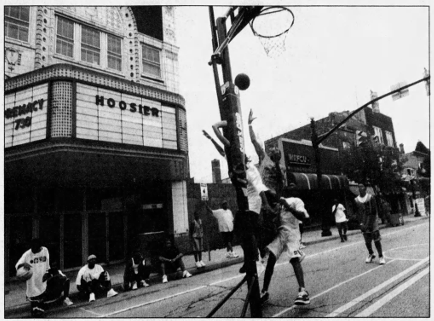
In 2004, Frank Brummett once again transformed the city when he introduced the “Let’s Go to the Hoop” 3-on-3 basketball tournament to 119th Street. That August, downtown Whiting was converted into multiple outdoor basketball courts, filling the street with players and spectators. The event was sponsored by Brummett’s printing company, Beryl Martin, and proceeds from the three-day tournament were donated to the Boys and Girls Clubs of America.
According to a Hammond Times article, tournament organizer Frank Brummett said that nearly 200 volunteers helped run the event, which even included a wheelchair division. “I love how you can look down 119th and see all the kids playing basketball,” he said.
And, of course, Brummett’s love of music had to be part of the celebration. To cap off the festivities, blues legend Koko Taylor performed a concert for the event’s participants and spectators, blending Brummett’s passions for community, sports, and live music into one memorable weekend.